
Tryp-N™: Better, More Certain Monoclonal Antibody Peptide Mapping
Related Articles
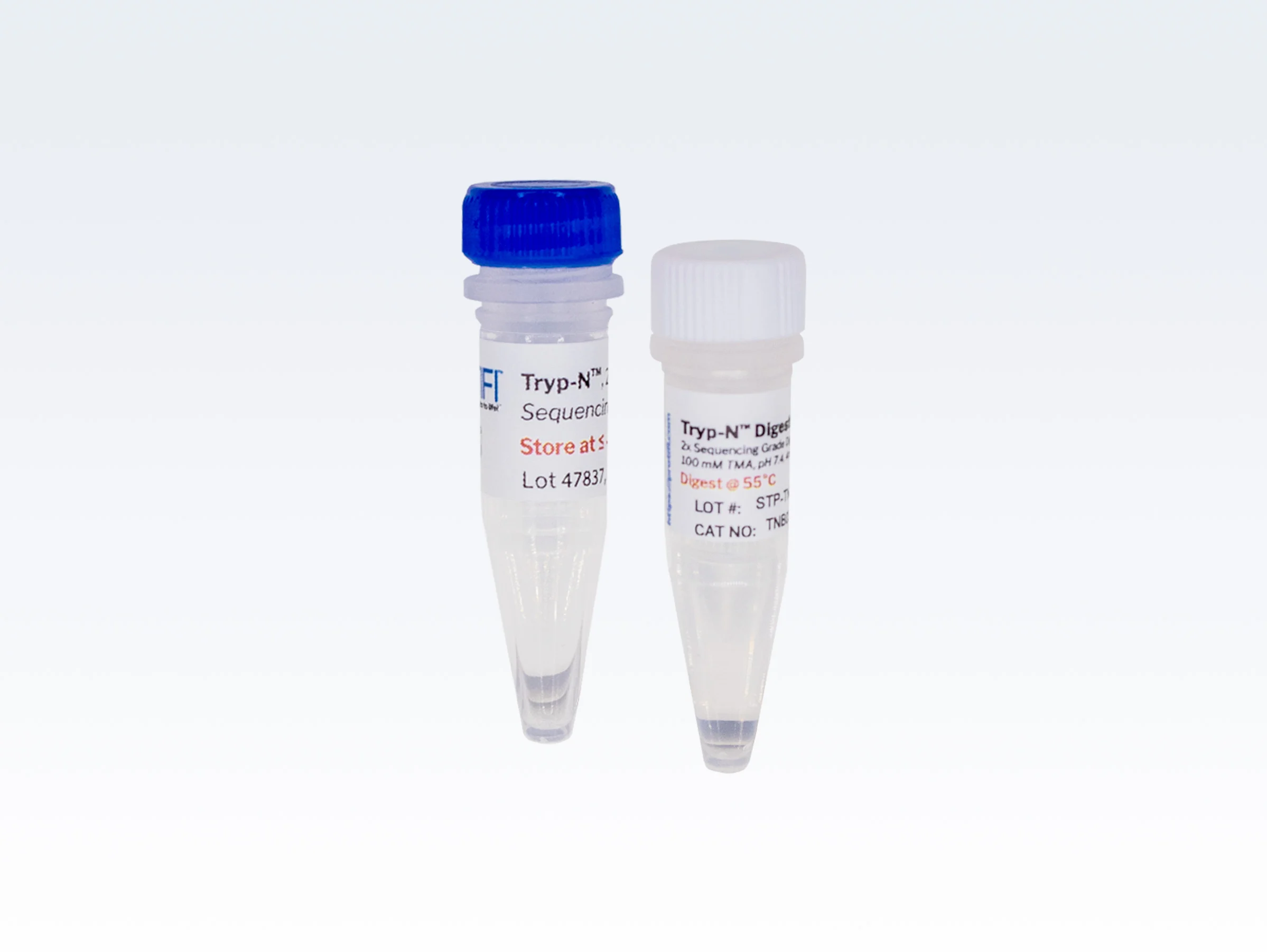
A new study highlights how Tryp-N™ is highly effective in LC-MS peptide mapping of monoclonal antibodies.
Using NISTmAb, bevacizumab, cetuximab, and trastuzumab, Sargautis and Thiede show how Tryp-N delivers sequence coverage comparable to and greater than trypsin, while also providing distinctly complementary fragmentation. Across all four antibodies, Tryp-N™ generated more peptide-spectrum matches than trypsin, with reported increases of 59% for trastuzumab, 35% for NISTmAb, 8% for cetuximab, and 7% for bevacizumab. For trastuzumab, Tryp-N™ achieved 100% sequence coverage for both heavy and light chains. Combining both enzymes further improved overall sequence coverage.
The greatest benefit was increased confidence in site-specific localization of modifications. Trypsin and Tryp-N™ both cleave at K/R, but on opposite sides. This produces complementary fragmentation patterns: tryptic peptides usually have strong y-ion series while Tryp-N™ yields strong b-ions. This orthogonality is particularly useful in determining sites of change like deamidation, oxidation, or single-amino-acid variants (SAVs); often, needed fragmentation ions may be too low in intensity or simply completely absent exactly in the regions needed for unambiguous site localization. The authors demonstrate that Tryp-N™ enabled confident localization and verification of the true site of such modifications, especially where spectra were obscured by noisy fragmentation.
The study also emphasized that software alone can misassign modified sites, especially in challenging spectra. Careful manual inspection of MS/MS data and/or use of multiple proteases is essential when high-confidence localization is required, and in particular when one digest gives ambiguous site assignments.
In sum, the study found Tryp-N™ as an exceptionally valuable mirror protease to trypsin. As a mirror protease to trypsin, it adds orthogonal evidence exactly where analytical certainty demands it, making Tryp-N™ especially useful for biosimilar comparability, sequence confirmation, multi-attribute method workflows, post-translational modification localization, and low-level variant analysis.
Domantas Sargautis, Bernd Thiede
Journal of Pharmaceutical and Biomedical Analysis 272 (2026) 117361
DOI: 10.1016/j.jpba.2026.117361
Read more about Tryp-N™ here: About Tryp-N™ – ProtiFi
