
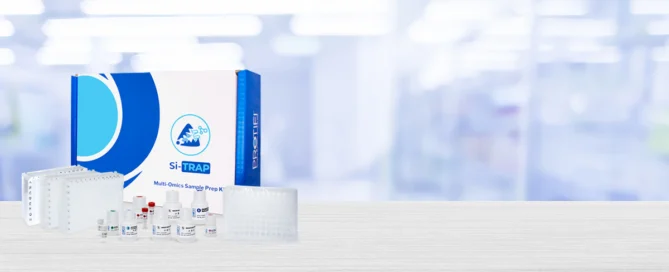
Evaluation of Si-Trap™ for Integrated Proteomic, Metabolomic, and Lipidomic Analyses

Multi-omics workflows enable proteins, metabolites, and lipids to be analyzed from the same biological system, providing a more complete view of cellular function. However, many established preparation strategies require separate sample inputs or splitting a single sample into multiple fractions to recover each omics layer. This added handling can increase preparation time, sample loss, and technical variability, making integrated analysis more challenging. To address these limitations, the Si-Trap™ was developed to streamline multi-omics sample preparation by enabling proteomic, metabolomic, and lipidomic analyses within a unified workflow. In collaboration with Proteomics and Metabolomics Facility (ProMeFa), the Si-Trap™ workflow was directly compared to the established ProMeFa multi-omics method using HEK293 cell pellets (Figure 1). The ProMeFa workflow employs water/MTBE/methanol phase separation to recover apolar lipid and polar metabolite fractions, with the remaining protein pellet resuspended in 9 M urea and processed by filter-aided sample preparation (FASP) prior to LC-MS analysis. In contrast, Si-Trap™ uses a 96-well plate format, in which samples are dissolved under detergent-free conditions before the addition of binding and lipid-extraction solutions. Proteins are retained on the trap, while metabolites and lipids are collected in the flow-through. Captured proteins are processed directly on the plate, including in situ reduction and alkylation, followed by proteolytic digestion and peptide elution for LC-MS analysis. Both the Si-Trap™ and ProMeFa workflows yielded broadly comparable results across multi-omics analyses. Proteomic analysis showed that most of the identified proteins were shared between the two workflows, indicating that Si-Trap™ achieved protein recovery comparable to that of the ProMeFa-FASP protocol. These proteins were distributed across major cellular compartments, reflecting broad proteome coverage by both methods. Metabolomic analyses identified similar metabolite classes in both workflows, including amino acids, nucleotides, organic acids, and related small molecules. In lipidomic analyses, both workflows recovered multiple lipid classes, with some workflow-dependent differences in class representation; The Si-Trap™ showed greater relative representation of diacylglycerols, while phosphatidylcholines and phosphatidylethanolamines were more represented in the ProMeFa workflow. The Si-Trap™ workflow integrates proteomic, metabolomic, and lipidomic sample processing within a single platform. In this comparative analysis, Si-Trap™ achieved molecular coverage comparable to the established ProMeFa workflow. Consolidation of sample preparation steps into a single format supports reproducible processing across molecular classes, reduces sample input requirements, and minimizes technical variability. Figure 1. Si-Trap™ demonstrates broad multi-omics coverage and strong signal recovery across metabolomics, proteomics, and lipidomics. Feature intensity distributions and molecular class representation were compared between the ProMeFa multi-omics workflow and Si-Trap™ using HEK293 cell samples. Proteomics (a), metabolomics (b), and lipidomics (c) outputs were evaluated for both workflows. Density plots display global feature intensity distributions, and pie charts summarize detected features by protein localization, metabolite category, or lipid class.

By |2026-07-22T11:26:37+00:00Jul 21, 2026|Article|Comments Off on Evaluation of Si-Trap™ for Integrated Proteomic, Metabolomic, and Lipidomic Analyses

One Workflow, Many Omics: Si-Trap™ Delivers Proteomic Depth and Metabolite Coverage

In collaboration with the Tamir Lab at UNC Chapel Hill, ProtiFi evaluated the Si-Trap™ as a true multi-omics workflow: one sample in, multiple omics out, without sacrificing analytical quality. Using MCF7 ER+ breast cancer cells, the Si-Trap™ was compared directly with a conventional urea-based proteomics method and a standard metabolite extraction. Si-Trap™ delivered greater proteome depth than urea while maintaining comparable metabolite detection. Across every proteomic comparison, the Si-Trap™ identified more proteins than the urea method. This improvement was observed in global proteome profiling as well as phosphoproteome and tyrosine phosphoproteome analyses, showing that the benefit was not limited to a single protein readout (Figures 1 and 2). Rather than simplifying sample preparation at the expense of sensitivity, the Si-Trap™ increased protein identifications while still supporting metabolomics from the same preparation. Metabolomics results were similarly encouraging. In positive ion mode, the Si-Trap™ matched the standard workflow, with 81 metabolites detected in each case. In negative ion mode, the Si-Trap™ detected 83 metabolites compared with 85 for the standard method. These findings show that Si-Trap™ preserved broad metabolite detection while delivering stronger proteomic depth (Figure 3). The Si-Trap™ thus removes one of the biggest barriers in multi-omics research: the need to choose between simplicity and analytical depth. By generating high-quality metabolomic and proteomic fractions from a single workflow, Si-Trap™ helps researchers gain more insight from every sample.

By |2026-04-30T03:01:36+00:00Apr 29, 2026|Article|0 Comments

The Si-Trap™: True Multi-Omics Sample Prep

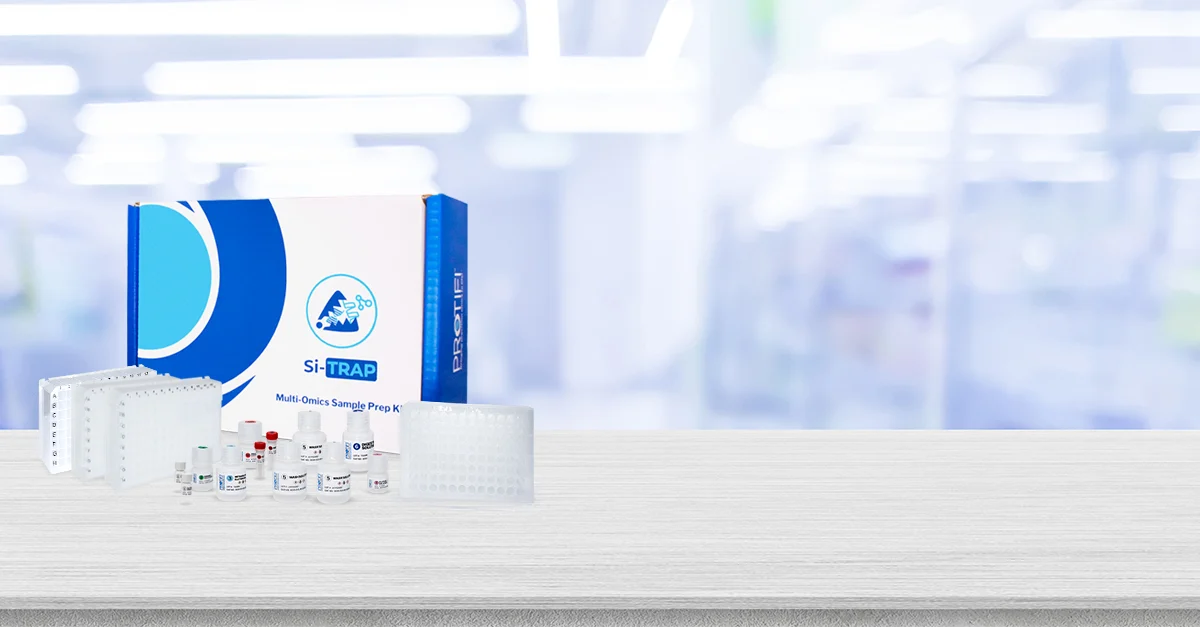
The Si-Trap™: fast, reproducible single-sample multi-omics!Multi-omics has enormous scientific value: biomolecules don't act in isolation and proteins, metabolites and lipids work together to effect life. Analyzing them together reveals more than studying any single class yet sample prep workflows remain omics-specific: split a sample (or get sequential slices) and independently work up each fraction. That's more handling, more variability and less confidence that the resulting datasets are truly paired: sample preparation and pre-analytical variation tend to be the largest sources of variability. Sample prep has simply lagged behind our multi-omics advances; we needed a better solution! Some approaches tried to address this. Methyl tert-butyl ether (MTBE)-based biphasic extraction (1) can separate a sample into a lipid-rich organic phase, an aqueous metabolite phase, and an insoluble protein-containing residue. SIMPLEX (2) built on this concept using a water/methanol/MTBE extraction, but at the cost of substantial sample manipulation that clogs automation. The Si-Trap™ was designed to solve that problem: one sample, multiple molecular classes, one integrated workflow (3). It gives truly integrated multi-omics sample preparation from a single sample. No splitting, no separate sample prep pipelines and no pellet handling. One protocol generates multiple analysis-ready omics fractions from the same biological input. It is designed for automation and delivers single-digit coefficients of variation. It's especially helpful where you have limited-input samples, biopsies or translational studies: all the situations where sample splitting increases variability and reduces data quality. The workflow begins with strong, detergent-free sample dissolution. After neutralization and denaturation with organic solvent, proteins are captured within derivatized Si-Trap™ pores through weak-affinity interactions. Metabolites and lipids pass through in a mass spectrometry-compatible format. The trapped proteins are then processed and digested in situ with the protease of choice to yield analysis-ready peptides. For a separate lipid fraction, use the optional lipid solution. In ProtiFi’s HuH-7 cell comparison, Si-Trap™ matched or exceeded standard S-Trap™ proteomic depth while producing higher signal for 93% of detected metabolites compared to a conventional acetonitrile extraction. Multi-omics sample preparation should be simple, reproducible, scalable and practical for real-world labs. Since sample preparation is already part of every workflow, why not recover all the major molecular fractions from the same sample? One sample in, multiple molecular classes and integrated biology out! Read more about Si-Trap™ in our previous post here. ReferencesMatyash V, Liebisch G, Kurzchalia TV, Shevchenko A, Schwudke D. Lipid extraction by methyl-tert-butyl ether for high-throughput lipidomics. J Lipid Res. 2008;49(5):1137–1146.Coman C, Solari FA, Hentschel A, Sickmann A, Zahedi RP, Ahrends R. Simultaneous Metabolite, Protein, Lipid Extraction (SIMPLEX): A Combinatorial Multimolecular Omics Approach for Systems Biology. Mol Cell Proteomics. 2016;15(4):1453–1466.Zougman A, Wilson JP, Roberts LD, Banks RE. Detergent-Free Simultaneous Sample Preparation Method for Proteomics and Metabolomics. J Proteome Res. 2020;19(7):2838–2844.  

By |2026-04-14T19:30:56+00:00Apr 14, 2026|Article|0 Comments

How the Si-Trap™ Enables True Multi-Omics: From Proteins, to Lipids, to Metabolites, All in One Workflow

Multi-omics workflows promise deeper biological insight, but sample preparation remains a significant bottleneck. Proteomics and metabolomics are typically collected in separate, parallel workflows, increasing handling and technical variability. Without a unified approach that generates multiple analysis-ready fractions from a single sample, reproducibility and scalability become harder to achieve.   To address this need, we present the Si-Trap™ (Simultaneous Trapping), a high-throughput, detergent-free multi-omics sample preparation platform designed to separate and capture proteins, lipids, and metabolites from one sample with inter- and intra-run reproducibility. The workflow starts with detergent-free lysis, followed by neutralization and organic-solvent denaturation. Proteins are captured within derivatized pores through weak-affinity interactions, while metabolites flow through as a small-molecules fraction compatible with direct mass spectrometry analysis. Trapped proteins are processed in situ on the 96-well plate (denaturation, reduction, and alkylation), digested with the user’s protease of choice, and peptides are subsequently eluted for LC-MS. We also offer an optional lipid extraction solution, that allows for biphasic separation and collection of lipids from the same sample.   Using HuH-7 cells under PFAS exposure as a representative model, we found that Si-Trap™ matched standard S-Trap™ proteomics depth while outperforming a standard ACN:MeOH extraction for 39 of 42 detected metabolites, delivering 1.0- to 7.5-fold higher signal. The Si-Trap™ also detected trends in biologically relevant metabolites that were not observed with the standard workflow. The Si-Trap™ can outperform conventional metabolomics extraction methods, without compromising proteomic recovery and depth.  By eliminating parallel prep workflows, Si-Trap™ reduces handling and variability while supporting scalable, automation-ready processing in a 96-well format. The result is a practical, time-saving, and cost-effective path to reproducible multi-omics sample preparation. Spend less time splitting samples and troubleshooting prep, and more time generating LC-MS data you can trust. Ongoing work is evaluating additional molecular classes to further expand coverage and maximize information recovered from samples.  Be on the lookout- Si-Trap™ is launching this month! 

By |2026-03-10T17:29:16+00:00Mar 10, 2026|Article|0 Comments

What to Expect at US HUPO 2026: New Technologies and Where to Find ProtiFi

Catch ProtiFi at US HUPO 2026 in St. Louis, MO at booth #21! We are excited to join leading scientists, researchers, and industry experts on the cutting edge of science on February 22 – 25th. What should you expect to see from ProtiFi? Check it out below. The highly sought after, first of its kind, multi-omics technology, the Si-Trap™. Be the first to see this industry leading technology set to launch in March. The Si-Trap™ is perfect for those with precious samples and looking for a cost-effective solution; allowing preparation of lipids, metabolites, and proteins all in one workflow! Find more information here or visit our poster during Poster Session 1 at poster P16.25. Do you have a need for more rapid sample preparation? Come by and check out the S-Trap™ Turbo™ Mini Plate and Kit. Stronger binding with less capture matrix allows smaller elution volumes elimination the need for additional concentration steps (and time). Designed for high-throughput workflows, the S-Trap™ Turbo™ integrates seamlessly into 96-well processing and automation platforms, making it well-suited for large cohort studies, discovery proteomics, and comparative screening applications. Need help with data analysis? SimpliFi™ makes organizing and visualizing complex omics data simple. Stop by our poster during Poster Session 2 at poster P04.14. Stop by the ProtiFi booth and we would be happy to discuss any of these new exciting products with you as well as the newly released S-Trap™ Micro Plate and other S-Trap™ products!

By |2026-02-27T02:08:21+00:00Feb 20, 2026|Article|0 Comments
Go to Top