
The Si-Trap™: True Multi-Omics Sample Prep
Related Articles



The Si-Trap™: fast, reproducible single-sample multi-omics!
Multi-omics has enormous scientific value: biomolecules don’t act in isolation and proteins, metabolites and lipids work together to effect life. Analyzing them together reveals more than studying any single class yet sample prep workflows remain omics-specific: split a sample (or get sequential slices) and independently work up each fraction. That’s more handling, more variability and less confidence that the resulting datasets are truly paired: sample preparation and pre-analytical variation tend to be the largest sources of variability. Sample prep has simply lagged behind our multi-omics advances; we needed a better solution!
Some approaches tried to address this. Methyl tert-butyl ether (MTBE)-based biphasic extraction (1) can separate a sample into a lipid-rich organic phase, an aqueous metabolite phase, and an insoluble protein-containing residue. SIMPLEX (2) built on this concept using a water/methanol/MTBE extraction, but at the cost of substantial sample manipulation that clogs automation.
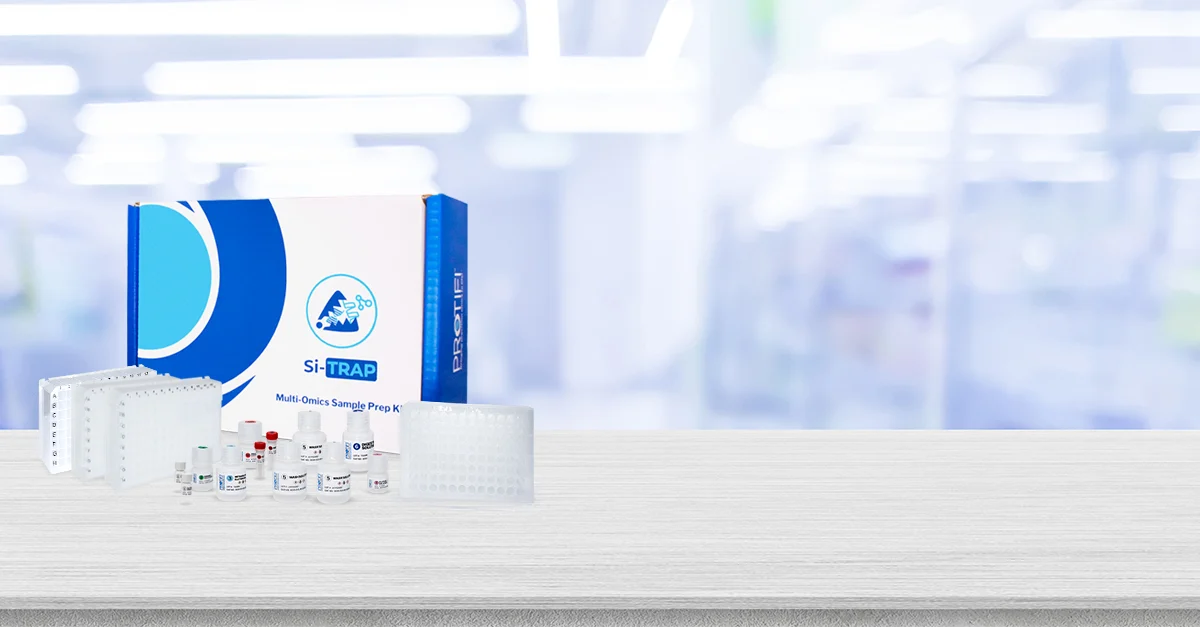
The Si-Trap™ was designed to solve that problem: one sample, multiple molecular classes, one integrated workflow (3). It gives truly integrated multi-omics sample preparation from a single sample. No splitting, no separate sample prep pipelines and no pellet handling. One protocol generates multiple analysis-ready omics fractions from the same biological input. It is designed for automation and delivers single-digit coefficients of variation. It’s especially helpful where you have limited-input samples, biopsies or translational studies: all the situations where sample splitting increases variability and reduces data quality.
The workflow begins with strong, detergent-free sample dissolution. After neutralization and denaturation with organic solvent, proteins are captured within derivatized Si-Trap™ pores through weak-affinity interactions. Metabolites and lipids pass through in a mass spectrometry-compatible format. The trapped proteins are then processed and digested in situ with the protease of choice to yield analysis-ready peptides. For a separate lipid fraction, use the optional lipid solution. In ProtiFi’s HuH-7 cell comparison, Si-Trap™ matched or exceeded standard S-Trap™ proteomic depth while producing higher signal for 93% of detected metabolites compared to a conventional acetonitrile extraction.
Multi-omics sample preparation should be simple, reproducible, scalable and practical for real-world labs. Since sample preparation is already part of every workflow, why not recover all the major molecular fractions from the same sample? One sample in, multiple molecular classes and integrated biology out!
Read more about Si-Trap™ in our previous post here.
References
- Matyash V, Liebisch G, Kurzchalia TV, Shevchenko A, Schwudke D. Lipid extraction by methyl-tert-butyl ether for high-throughput lipidomics. J Lipid Res. 2008;49(5):1137–1146.
- Coman C, Solari FA, Hentschel A, Sickmann A, Zahedi RP, Ahrends R. Simultaneous Metabolite, Protein, Lipid Extraction (SIMPLEX): A Combinatorial Multimolecular Omics Approach for Systems Biology. Mol Cell Proteomics. 2016;15(4):1453–1466.
- Zougman A, Wilson JP, Roberts LD, Banks RE. Detergent-Free Simultaneous Sample Preparation Method for Proteomics and Metabolomics. J Proteome Res. 2020;19(7):2838–2844.
